

Introduction
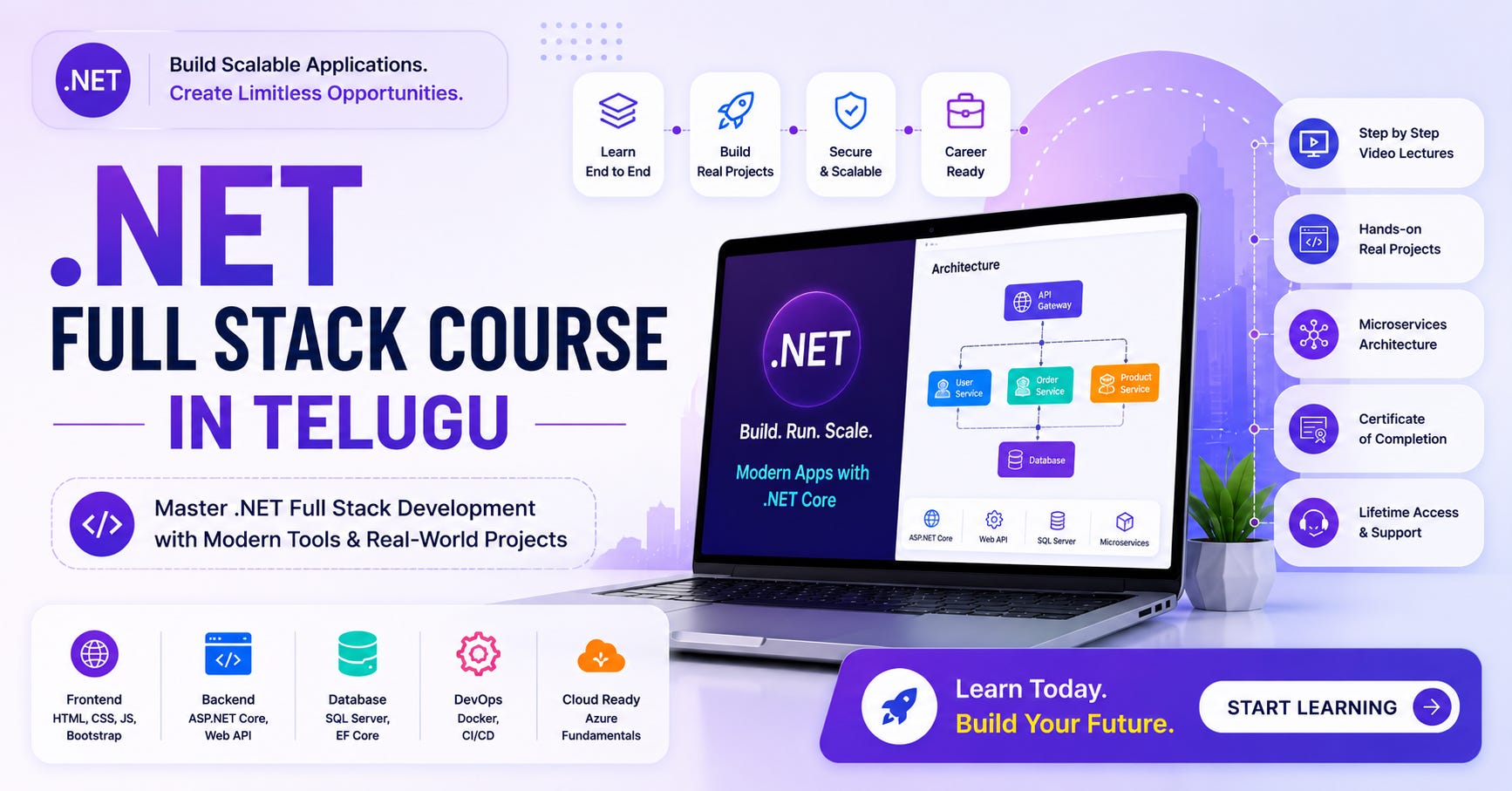
The demand for full stack developers continues to grow as businesses seek professionals who can build secure, scalable, and high-performing applications. Mastering technologies like C#, ASP.NET Core, and Microservices provides a strong foundation for developing modern enterprise solutions. A .NET Full Stack Course in Telugu is designed to help learners understand these technologies through practical training, real-time projects, and industry-oriented learning. Whether you are starting your programming journey or upgrading your technical skills, this comprehensive course prepares you for the evolving software development landscape.
Learn the Fundamentals of C# Programming
C# is one of the most widely used programming languages for building desktop, web, and enterprise applications. Understanding its core concepts is the first step toward becoming a proficient .NET developer.
Students learn:
Variables and data types.
Conditional statements.
Loops and iteration.
Functions and methods.
Object-oriented programming concepts.
Exception handling techniques.
A strong command of C# helps learners write clean, efficient, and maintainable code for professional applications.
Master ASP.NET Core for Modern Web Development
ASP.NET Core is a powerful framework for developing secure and high-performance web applications that run across multiple platforms.
The learning process includes:
Building dynamic web applications.
Creating MVC-based projects.
Managing routing and controllers.
Handling forms and user input.
Implementing dependency injection.
Configuring application settings.
These skills enable developers to create robust applications suitable for businesses of all sizes.
Understand the Power of Microservices Architecture
Modern organizations are moving away from monolithic applications and adopting microservices to improve flexibility and scalability.
Students gain knowledge about:
Service-based application architecture.
Independent service development.
Communication between services.
Scalable application design.
Fault isolation techniques.
Simplified application maintenance.
Learning microservices prepares developers for enterprise software projects that require modular and distributed systems.
Build End-to-End Business Applications
Practical implementation is essential for understanding how different technologies work together.
Students develop applications that include:
Interactive user interfaces.
Business logic implementation.
Database integration.
Secure user authentication.
API communication.
Deployment-ready architecture.
These projects provide valuable real-world experience and improve technical confidence.
Strengthen Backend Development Skills
Backend development is responsible for processing requests, managing business rules, and handling application data efficiently.
Learners improve their expertise in:
Server-side programming.
Business logic implementation.
Request processing.
Data validation.
Exception management.
Performance optimization.
These backend skills are essential for developing enterprise-grade software solutions.
Learn Database Management and Integration
Every modern application depends on efficient database management to store and retrieve information accurately.
Students gain practical experience in:
Designing relational databases.
Creating efficient table structures.
Performing CRUD operations.
Writing optimized queries.
Managing data relationships.
Maintaining database consistency.
Strong database knowledge supports the development of reliable business applications.
Develop Secure and Scalable Applications
Security and scalability are fundamental requirements in modern software development.
Important learning areas include:
User authentication.
Role-based authorization.
Secure data handling.
Application validation.
Resource optimization.
Scalable architecture design.
Applying these concepts helps developers create dependable applications that support business growth.
Work with RESTful APIs and Service Integration
Modern applications communicate with multiple systems using APIs to exchange data and extend functionality.
Students learn how to:
Build RESTful APIs.
Handle client-server communication.
Process API requests.
Validate data efficiently.
Integrate multiple services.
Improve application interoperability.
API development is an essential skill for building connected software ecosystems.
Gain Practical Experience Through Real-Time Projects
Hands-on learning helps students apply theoretical concepts to real business scenarios.
Project experience includes:
Employee Management Systems.
E-commerce Platforms.
Hospital Management Applications.
Inventory Management Solutions.
Customer Relationship Management software.
Online Service Portals.
These projects strengthen development skills while creating a professional portfolio.
Prepare for High-Demand Software Development Careers
Mastering C#, ASP.NET Core, and Microservices significantly improves career prospects in the IT industry.
Career opportunities include:
Full Stack Developer.
.NET Developer.
Software Engineer.
Backend Developer.
API Developer.
Enterprise Application Developer.
Solutions Architect (entry-level pathway).
Technical Consultant.
These roles offer excellent opportunities for professional growth across startups, service companies, and product-based organizations.
Stay Ready for Future Technology Trends
Technology continues to evolve, making continuous learning an important part of every developer’s journey.
Developers can further expand their expertise in:
Cloud computing platforms.
DevOps practices.
Containerization technologies.
Distributed application development.
Enterprise software architecture.
Artificial Intelligence integration.
Keeping pace with emerging technologies ensures long-term success and adaptability in the software industry.
Conclusion
A comprehensive course covering C#, ASP.NET Core, and Microservices equips learners with the practical knowledge needed to build modern, scalable, and secure software applications. Through structured learning, hands-on projects, database integration, API development, and enterprise architecture concepts, students gain the confidence to handle real-world software development challenges. By mastering these in-demand technologies, aspiring developers position themselves for rewarding careers and long-term success in today’s rapidly evolving IT industry.