

Introduction
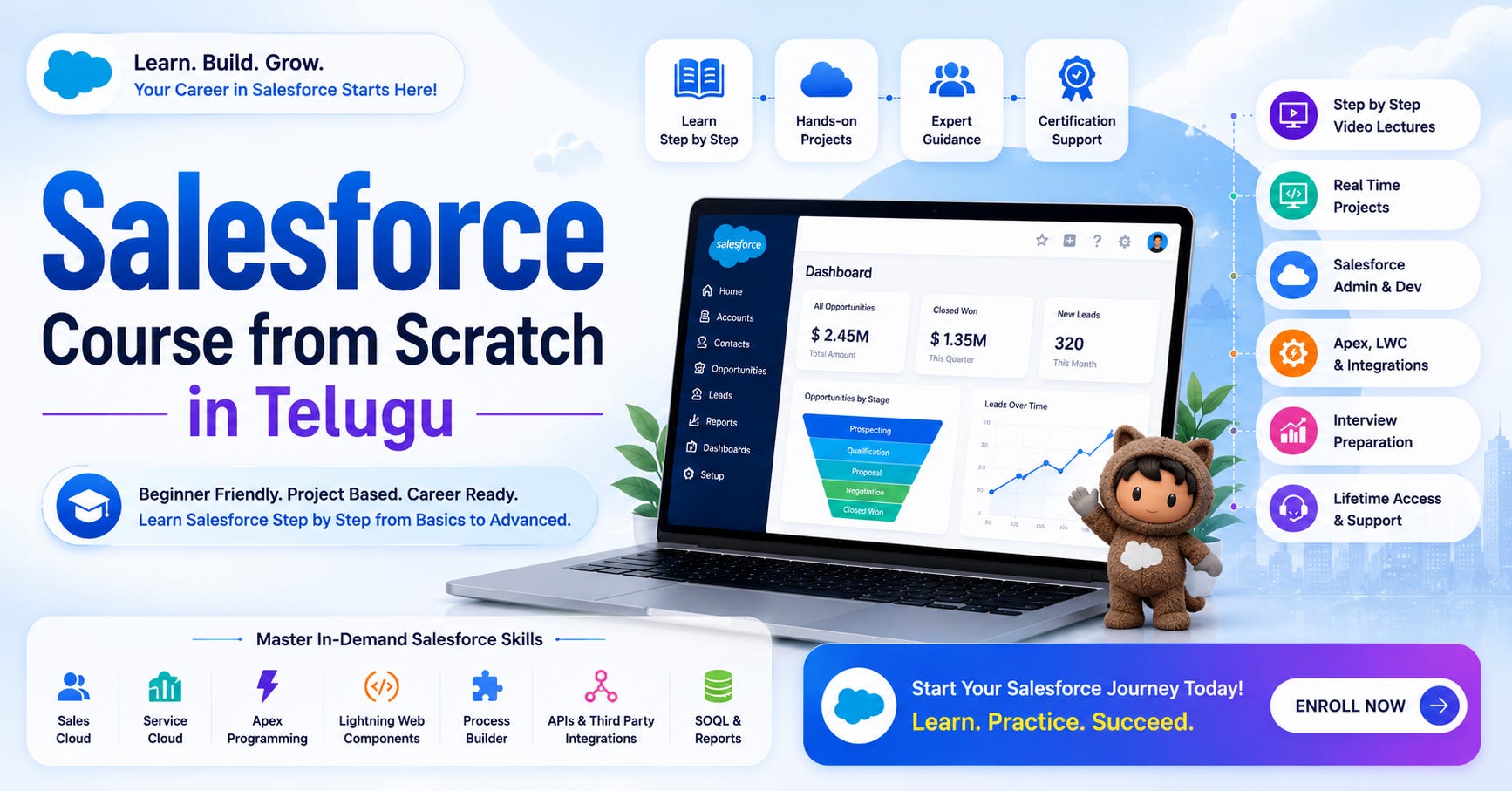
The demand for Salesforce professionals continues to rise as organizations adopt cloud-based CRM solutions to improve customer engagement and business efficiency. Learning advanced Salesforce concepts with practical implementation and career guidance helps learners become industry-ready. A Salesforce Course from Scratch in Telugu offers a structured learning path that starts with CRM fundamentals and gradually progresses to advanced platform capabilities, real-time projects, and placement-oriented preparation. With the right combination of technical training and career support, learners can confidently pursue opportunities in the rapidly growing Salesforce ecosystem.
Why Choose an Advanced Salesforce Learning Path
An advanced learning program helps learners move beyond basic platform knowledge and develop the practical expertise required for enterprise-level projects.
Some key advantages include:
Comprehensive understanding of the Salesforce platform.
Exposure to advanced business solutions.
Practical implementation through real-time projects.
Better understanding of enterprise workflows.
Improved technical confidence.
Strong preparation for professional careers.
A structured learning journey ensures steady progress from beginner to advanced levels.
Building a Strong CRM Foundation
Every successful Salesforce professional begins with a clear understanding of Customer Relationship Management and its role in modern businesses.
Important foundational concepts include:
CRM principles and objectives.
Customer lifecycle management.
Sales and service operations.
Lead and opportunity tracking.
Business workflow understanding.
Customer engagement strategies.
These concepts provide the knowledge needed to understand advanced Salesforce features effectively.
Mastering Core Salesforce Features
A strong understanding of platform capabilities is essential before exploring advanced development and administration topics. Salesforce Course from Scratch in Telugu helps learners build expertise through practical learning and guided implementation.
Core learning areas include:
Platform navigation.
User and profile management.
Security and permission settings.
Custom objects and fields.
Reports and dashboards.
Data management techniques.
These skills form the backbone of every Salesforce implementation.
Exploring Advanced Customization Techniques
Organizations often require solutions tailored to their unique business processes. Advanced customization enables professionals to design applications that meet these specific requirements.
Customization topics generally include:
Business application configuration.
Advanced page customization.
Complex validation rules.
Custom business processes.
User experience improvements.
Scalable application design.
Learning these techniques helps professionals deliver flexible enterprise solutions.
Working on Enterprise-Level Projects
Real-world projects provide practical experience that prepares learners for professional environments. Industry-oriented assignments help bridge the gap between theory and implementation.
Project activities include:
Analyzing business requirements.
Building CRM solutions.
Implementing automation.
Managing enterprise data.
Creating business reports.
Solving implementation challenges.
Hands-on projects improve both technical expertise and practical confidence.
Learning Automation for Business Efficiency
Automation is one of the most valuable features of Salesforce because it simplifies repetitive business activities and improves operational productivity.
Automation learning covers:
Workflow creation.
Approval process implementation.
Automated task assignment.
Notification management.
Business rule execution.
Process optimization.
Understanding automation enables professionals to build efficient business solutions.
Placement-Oriented Skill Development
Technical knowledge alone is not enough to secure employment. Career-focused training helps learners prepare for recruitment processes with greater confidence.
Placement preparation includes:
Resume building.
Portfolio development.
Mock interview sessions.
Technical question practice.
Communication improvement.
Interview confidence building.
These activities improve employability while preparing learners for competitive job opportunities.
Developing Professional Workplace Skills
Modern organizations value professionals who combine technical expertise with effective workplace skills. Building these qualities contributes to long-term career growth.
Essential professional skills include:
Business communication.
Analytical thinking.
Team collaboration.
Time management.
Problem-solving ability.
Adaptability to changing technologies.
These skills enhance workplace performance and career progression.
Career Opportunities After Advanced Training
Completing advanced Salesforce training creates opportunities across industries that rely on cloud-based CRM solutions for business operations.
Some promising career roles include:
Salesforce Administrator.
Salesforce Developer.
CRM Consultant.
Business Analyst.
Salesforce Technical Consultant.
Solution Architect.
As organizations continue expanding their digital transformation initiatives, experienced Salesforce professionals remain highly sought after.
Conclusion
An advanced Salesforce learning program combined with placement assistance provides learners with the technical knowledge, practical experience, and career preparation needed to succeed in today’s competitive job market. From mastering CRM fundamentals and advanced customization to working on enterprise projects and preparing for interviews, every stage contributes to building industry-ready professionals. With continuous learning, hands-on practice, and structured career guidance, aspiring candidates can confidently build successful careers in the Salesforce ecosystem and take advantage of the growing opportunities in cloud technology.